
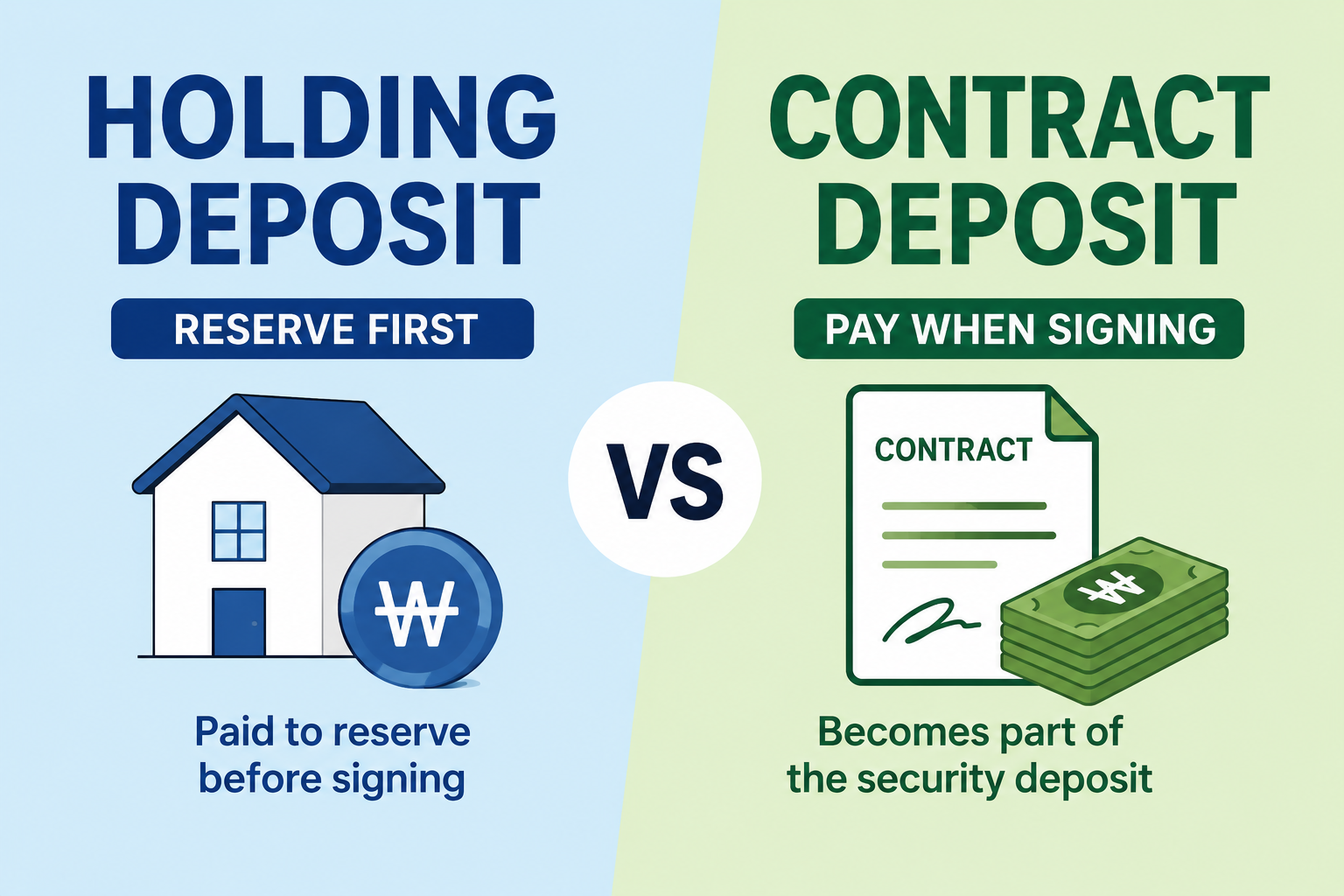
Many foreigners are confused about the difference between a Holding Deposit and a Contract Deposit in Korea. Although both payments are made before moving in, they serve different purposes.
🟢 Holding Deposit
A Holding Deposit is paid to reserve a property before the lease agreement is signed. Once the landlord and tenant agree on the main lease terms, the property is usually taken off the market and reserved for you.
For short-term rentals, the holding deposit is often treated as the contract deposit because the security deposit is relatively small. In many cases, no additional contract deposit is required later.
🟢 Contract Deposit
A Contract Deposit is paid when the lease agreement is officially signed. This payment confirms the contract and becomes part of your total security deposit.
For long-term rentals, the contract deposit is typically 10% of the total security deposit. Since the security deposit for long-term rentals can be quite large, many tenants first pay a smaller Holding Deposit to reserve the property. When the lease is signed, they simply pay the remaining amount needed to complete the 10% contract deposit.
🟢 Example
Long-Term Rental
Total Security Deposit: KRW 20,000,000
Required Contract Deposit (10%): KRW 2,000,000
Holding Deposit Paid: KRW 500,000
When signing the lease, the tenant pays the remaining KRW 1,500,000 to complete the contract deposit. The full KRW 2,000,000 is then counted toward the total security deposit.
| Holding Deposit | Contract Deposit |
|---|---|
| Paid before signing the lease | Paid when signing the lease |
| Reserves the property | Officially confirms the lease agreement |
| Usually a smaller amount | Typically 10% of the security deposit |
| Often the same as the contract deposit | Becomes part of the total security deposit |
**Please note: The exact process may vary depending on the landlord or real estate agency. Always confirm the payment schedule and terms before transferring any money.